
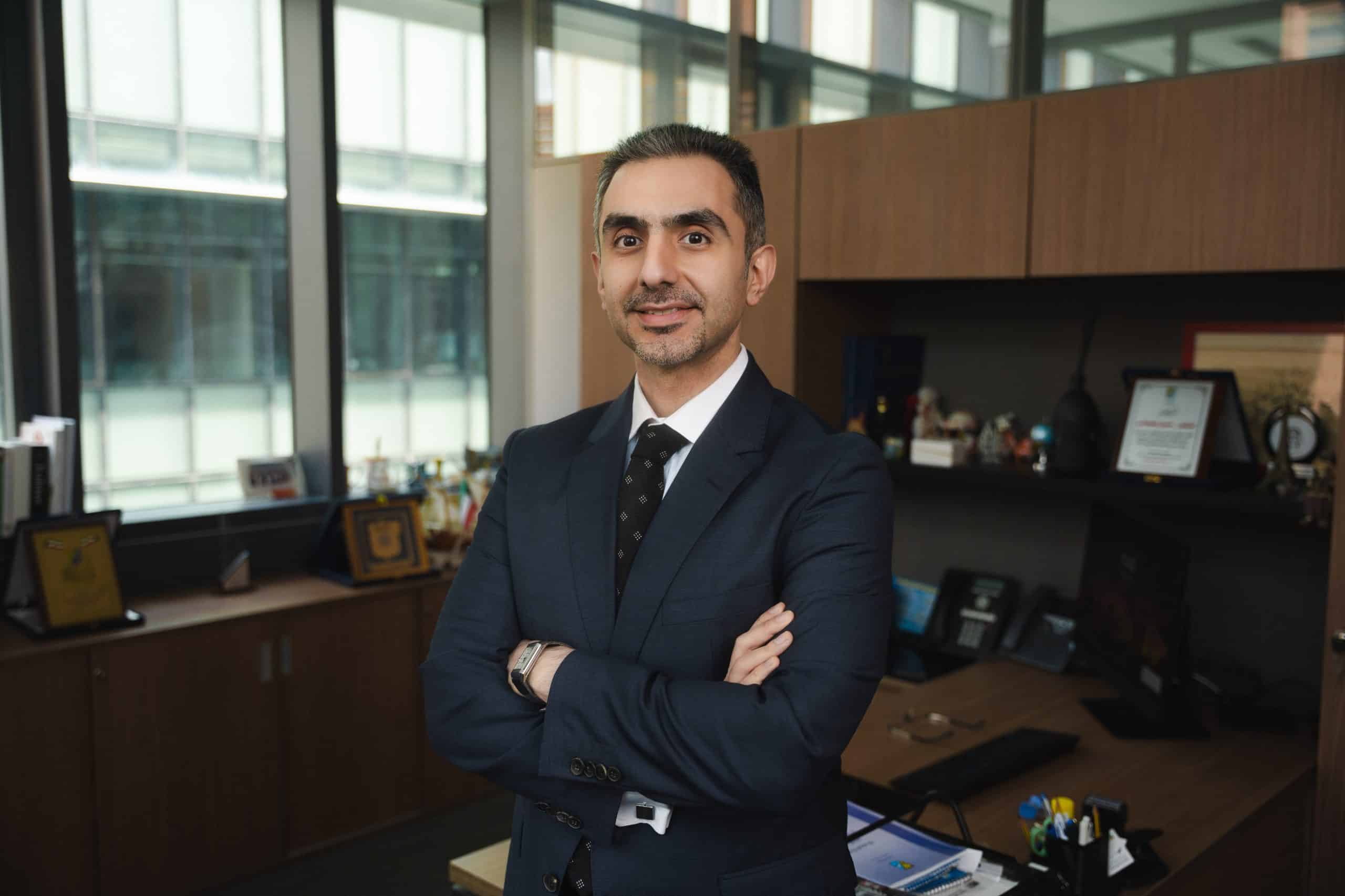
Professor Hussain Bahbahani
Reading the Genome of the Desert’s Defining Animal
No one can pinpoint exactly when dromedary camels arrived on the Arabian Peninsula, but these humped animals undoubtedly dramatically shaped the civilizations that took root there. The ancient Arab writer al-Jahiz is said to have called the camel "the complete animal" of the desert — almost miraculously suited to a landscape that defeats other large creatures. While humans begin to falter after losing five percent of their body weight to dehydration, a camel can go up to a month without drinking, shed more than a quarter of its body weight in fluids, and then rehydrate by consuming up to 110 liters of water in 10 minutes.
It can also let its body temperature climb from 34 to over 40 degrees Celsius, which reduces its sweating, since a hotter body requires less evaporative cooling. Able to live on sparse, spiny vegetation, camels can carry loads of several hundred pounds across terrain where wheeled vehicles founder — making settlement possible and trade routes viable long before a single road was built.
But how did camels acquire the ability to concentrate their urine down to such a level that it becomes three times saltier than seawater? How do genes govern the fat stored in their iconic hump, or establish the two rows of lashes that protect their eyes from the sand that desert winds kick up? These are the questions driving the work of Prof. Hussain Bahbahani, a geneticist and professor at Kuwait University, who studies population genomics in livestock — a field that compares DNA across large groups of animals to reveal how evolution has shaped their genetic code. For his research, he received a 2025 Jaber Al-Ahmad Prize.
Like many Kuwaitis today, Prof. Bahbahani has little personal connection with camels beyond the occasional desert camping trip in winter, when the weather turns cool enough to venture out and camels roam visibly across the open terrain. Unsurprisingly, then, he came to study this animal by a roundabout path.
As a doctoral student at the University of Nottingham in the United Kingdom, Prof. Bahbahani studied how African cattle populations had genetically adapted to their local environments. After graduating, a close collaborator, Prof. Faisal Almathen of King Faisal University in Saudi Arabia, urged Prof. Bahbahani to turn his bioinformatic expertise toward a new subject. “Let’s study something that all the Arabian Gulf countries will get the benefit of,” Prof. Bahbahani recalled Prof. Almathen suggesting. “The symbol of our countries. That is the camel, of course.”
Although trucks and airplanes have now long since replaced camels as the primary means of transport across the Arabian Peninsula, they are still widely kept – for racing but also for their milk, meat, and hides. Camel milk was now even used to produce chocolate, Prof. Bahbahani noted.
Their role as livestock made it imperative to decode their genes, he argued: “To have food security, you need to better understand your domestic species,” he said.

With collaborators, Prof. Bahbahani set out to conduct the first whole-genome analysis of dromedary populations across the Arabian Peninsula. He quickly ran into an obstacle. "Camel owners usually don't like people touching their camels with needles," he learned. To obtain the blood samples he needed, he enlisted veterinarians, whose presence the owners were more willing to accept. Eventually, he and his team assembled samples from 12 distinct camel populations across Kuwait, Saudi Arabia, and Oman.
By sequencing and comparing the full genomes of these dromedaries, Prof. Bahbahani established that the Arabian camels fall into four broad genetic groups that correspond to different parts of the Peninsula, though with considerable intermingling. The pattern seems to fit with the Peninsula’s long history of caravan trade and the movement of animals during religious pilgrimages. The team also identified regions where evolution has acted most forcefully: sections of DNA that show signs of positive selection, likely because they conferred a survival advantage.
Among them were regions containing genes related to kidney function and, by extension, water conservation. The team also found genes associated with, for example, fertility (which can be a challenge for many species under heat stress), immunity, eyesight, and neurological pathways related to brain development, which may help underpin dromedaries’ famous spatial memory when navigating vast and featureless deserts. “These are interesting biological pathways that may relate to the camel's adaptation to its environment,” Prof. Bahbahani said.
Recently, he has turned his attention to a particular subset of camels: those bred for racing. Although camel racing is deeply embedded in Gulf culture and carries considerable prize money, breeders have so far relied mainly on a camel’s appearance and its race history – rather than its genetics – when deciding which animals to mate. Genomics, Prof. Bahbahani believes, could offer a more reliable guide. His research has identified genes linked to cartilage development and muscle strength that show signs of positive selection. In other words: These traits may well relate to running performance, though more research is needed to confirm the connection.
Scientific interest in camels is growing, Prof. Bahbahani noted. Researchers across the Gulf are now studying these animals from multiple angles, from how their bodies function and are built to the chemistry of their milk. Yet whole-genome analysis remained more limited, said Prof. Bahbahani: For that, “we need scientists with good training in bioinformatic tools. This is the missing part.”
He would like to see camel owners follow the lead of many cattle and sheep farmers by running formal breeding programs guided by DNA profiles to predict which animals will be the best producers of milk and meat, or the fastest racers. A country cannot rely on imported or exotic livestock alone, he argued. “You don’t know what will happen. One day you are able to import these animals, but another day you may not. So you need to raise an indigenous population adapted to your local environment.”