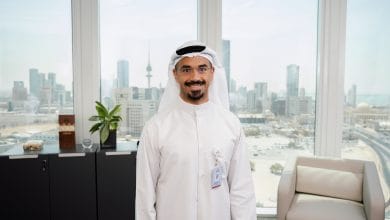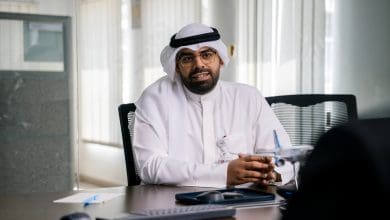
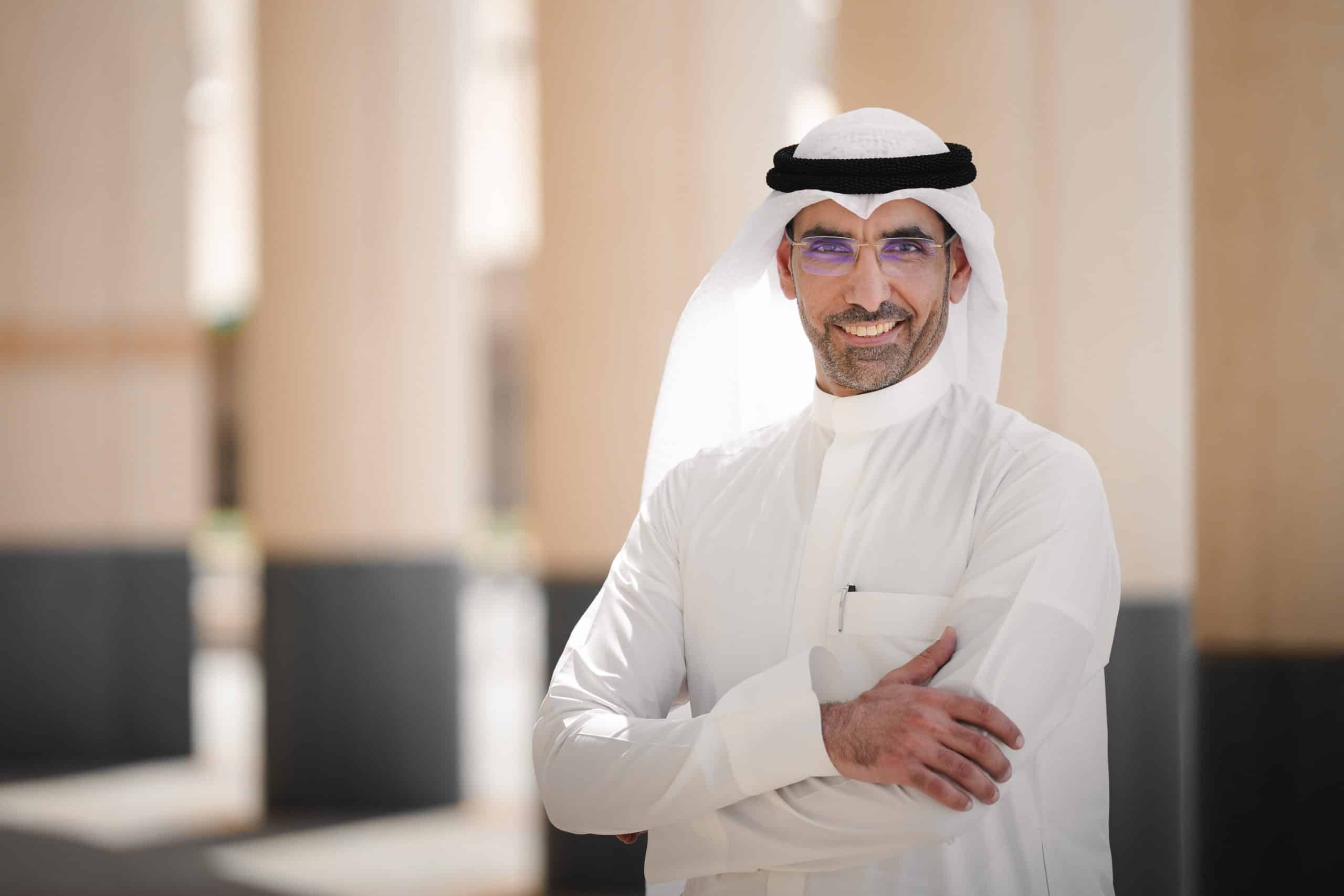
Professor Yousuf Al-Khezi
Studying the Beautifully Simple Structures Underneath Complexity
Most people get math all wrong. “The most common misconception is that mathematics is essentially about calculation — that being good at mathematics means being fast with numbers,” said Yousuf Al-Khezi, a full professor of mathematics at the Public Authority for Applied Education and Training (PAAET)- College of Basic Education (CBE). “In reality, professional mathematics has very little to do with arithmetic.”
What mathematicians actually spend most of their time doing, Al-Khezi explained, is constructing arguments, identifying patterns, and figuring out why things are true. “Doing mathematics is much closer to artistic or philosophical thinking than most people would expect,” he said.

This may sound abstract, yet mathematics touches all of us. Mathematical insights shape how engineers design safer bridges, how doctors reconstruct images from MRI scans, how search engines rank results, and how banks secure transactions. Disease outbreaks are modeled with mathematics. So are traffic flows, weather systems, and the algorithms behind artificial intelligence.
“Mathematics research matters because it builds the framework behind better decisions, better technologies, and deeper understanding of the world,” said Al-Khezi.
His own love for the field developed, driven by a teacher who presented mathematics as a way of thinking rather than a set of formulas. Al-Khezi began to admire mathematics’ inner logic and consistency, marvelling how each step in a proof inevitably led to a conclusion. He realized that different areas of math, like algebra and geometry, are deeply connected — like different views of the same landscape. “I'm fascinated by the idea that complex systems often hide beautifully simple structures underneath — whether that's symmetry in geometry or patterns in number theory. There's something deeply satisfying about uncovering an elegant principle that was always there, just not immediately visible,” he said.
After earning his undergraduate degree at Kuwait University, Al-Khezi pursued a Master’s degree at Bowling Green State University in Ohio - USA and then a doctorate at the University of Texas at Arlington - USA, where he specialized in algebra. He returned to Kuwait in 2015 and has been on the mathematics faculty at PAAET – College of Basic Education ever since, now also serving as Chair of both the Mathematics and Science Departments at the College of Basic Education. He received a 2025 Jaber Al-Ahmad Prize for Young Researchers in Natural and Mathematical Sciences.
Much of his research focuses on three closely linked areas of pure mathematics: commutative algebra, homological algebra, and tensor products.
For all their abstraction, these fields sit at the heart of technologies that many people encounter every day. Algebraic structures studied in commutative algebra underlie the encryption systems that secure online banking and private messages. Homological ideas power techniques that detect hidden patterns — loops and voids — in large, messy data sets, a method now used in fields from cancer research to materials science. And tensor structures are woven into the inner workings of the AI models that have become part of daily life, from voice assistants to image recognition.
Al-Khezi’s more recent work has extended into so-called fractional partial differential equations — advanced mathematical tools used to model fluid flow, heat transfer, and wave propagation. He has also conducted research on encryption and digital signatures, and on image inpainting: the mathematical process by which damaged or incomplete images are repaired.

For Al-Khezi, the gap between mathematics’ abstract nature and its real-life applications is one of the field’s greatest charms. “Mathematics doesn’t set out to be useful,” he said, “and yet it almost always becomes useful, often in ways that weren’t anticipated when the theory was first developed.” It’s something he finds deeply motivating.
He also loves how creative the discipline is. Mathematics was widely perceived as cold and mechanical, he said: follow the rules, arrive at the answer. But in practice, intuition played a central role, especially in research. “Before you can write a rigorous proof, you usually need a feeling for why something should be true,” said Al-Khezi. “Two mathematicians can solve the same problem through completely different approaches and both be correct, which I find genuinely exciting.”
It is a deeply social undertaking, he stressed. “Ideas develop through conversation, seminars, and collaboration, often across very different subfields. Some of the most interesting progress happens at the boundaries between areas that weren’t previously connected.”
As Al-Khezi noted, much of the field remains to be explored: "Mathematics is not a finished subject. There are fundamental questions that remain completely open, some of which have resisted the efforts of the best mathematical minds for centuries. The subject is very much alive.”