
On the first day of Harvard University’s Program for Leadership Development (PLD), Mona Al-Duaij surprised even herself. “I need to learn how to delegate,” she told the instructors. “I need to trust my team more. I need to give them more confidence and more freedom, allowing them to learn and even correct themselves.”
For someone who had spent two decades steadily climbing through the ranks of Boubyan Bank, the admission was deeply personal. Al-Duaij already held one of the institution’s most senior executive positions. Yet rather than arriving at Harvard believing she had mastered leadership, she arrived convinced there was still something fundamental she needed to change. The same mindset shaped two leadership programs supported by the Kuwait Foundation for the Advancement of Sciences (KFAS).
Al-Duaij’s leadership journey began much earlier. After graduating with a degree in Finance from Kuwait University in 2005, she joined Boubyan Bank in November of the same year, at a time when the institution itself was still taking shape. Over the following two decades, she moved through roles spanning the branch network, operations and control, branch support, retail channels and executive management before being appointed Group Chief Compliance and Governance Officer in January 2021. Rather than changing employers every few years—a career strategy often recommended to ambitious professionals—Al-Duaij built her career by moving horizontally across very different functions within the same organization.
“I joined Boubyan while it was still in its establishment phase,” she recalls. “In a way, we all grew together.”
That experience exposed her to almost every aspect of the bank, from customer-facing operations to back-office support, governance and eventually regulatory oversight. Each move required learning an entirely new discipline while building on the experience gained in the previous one. But her greatest professional transition came in early 2021, when the bank’s CEO asked her to leave the operational side of the business and take responsibility for Compliance, Governance and Anti-Money Laundering. Accepting the position meant stepping into one of banking’s most technically demanding and highly scrutinized functions. “It was a difficult decision,” she says. Yet she accepted immediately.
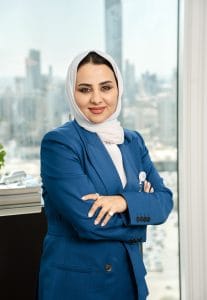
Today, as Group Chief Compliance and Governance Officer, Al-Duaij oversees one of the bank’s most independent functions. Her team ensures compliance with regulations issued by the Central Bank of Kuwait, monitors anti-money laundering controls, reports directly to the Board’s Risk and Compliance Committee on governance matters, and serves as the bank’s official liaison with regulators. The role demands independence as much as technical expertise. Compliance, she says, is often misunderstood as a department whose purpose is simply to say “no.” Her own appointment reflected a different philosophy. When offering her the position, the CEO explained his reasoning. “I don’t want someone whose background is only in regulation and who simply says ‘No’ to everything,” he told her. Because she had spent years working across the bank, she already understood its business, products and people. That broader perspective enabled her not only to interpret regulations but also to help business teams find practical ways to comply with them while continuing to innovate. That balance between regulation and innovation would later become even more relevant as AI began reshaping financial services.
Al-Duaij believes AI offers enormous opportunities—from detecting suspicious transactions more efficiently to strengthening compliance monitoring and improving operational performance. At the same time, she says, AI introduces new risks. Cybersecurity, data privacy, governance, and ethics all become part of the compliance agenda. “We need to understand those risks first and then develop the right controls.”
Long before AI became central to banking, Al-Duaij had already invested heavily in her own development through executive education. With support from KFAS, she participated in UCLA’s leadership programme in 2018 before completing Harvard University’s Program for Leadership Development (PLD), graduating in January 2026. The bank nominated three executives for the Harvard programme, and KFAS selected her to participate. Although regional instability prevented her from returning to campus later that year as originally planned, she intends to continue building her relationship with Harvard and its alumni community when circumstances allow.
“They gave me confidence,” she says. “They gave me exposure. And they gave me relationships.”
Those relationships remain active today. Even after completing the programmes, she remains in touch with fellow participants from different organizations and industries. The network they built, she says, continues to expose her to new ideas and different perspectives beyond the banking sector.
Before Harvard, Al-Duaij says she arrived at the office each morning and immediately immersed herself in work. After Harvard, her routine changed completely. She now closes her office door for a few minutes at the beginning of each day, organizes her thoughts, writes down priorities and mentally prepares for the day ahead. The change extended beyond personal habits. She deliberately gives her team greater responsibility, encourages independent decision-making and resists the perfectionism that once made her reluctant to delegate. “Those may sound like small changes,” she says, “but they’ve genuinely changed my life and the way I work every day.” Leadership, she believes, also requires constant self-awareness. People who believe they have nothing left to learn often become trapped by their own ego. Every leader—even a chief executive—has areas that require improvement. For women in particular, she believes leadership requires balancing professional responsibilities with family life. Without that balance, she says, many talented leaders eventually find themselves forced to make difficult choices.
Looking back over twenty years at Boubyan Bank, Al-Duaij says her proudest achievement is not a title. It is watching people she once mentored become leaders themselves.
“When I see someone who started with me years ago becoming a manager or a leader today,” she says, “that gives me much more satisfaction than having another promotion.”
Sure, becoming Group Chief Compliance and Governance Officer remains an important milestone in her career. Yet when she thinks about success, her mind goes elsewhere. “When I see someone who started with me years ago becoming a manager or a leader today,” she says, “that gives me much more satisfaction than another promotion.”