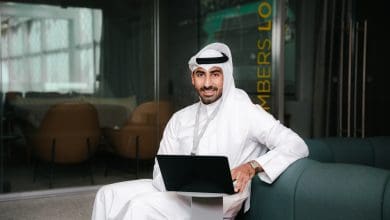

On a Wednesday evening at around seven o’clock, Dhari Alawwad picked up the phone and called Jazeera Airways. At the time, he was working for Kuwait’s Directorate General of Civil Aviation during the COVID-19 pandemic, coordinating one of the country’s most urgent digital projects: introducing QR codes across airport terminals and linking them to the Ministry of Health’s systems. Everything had to be ready before the Minister of Health arrived for an inspection on Sunday.
“I’ll provide you with all the data you need,” he told his counterpart at Jazeera Airways. “I want everything implemented by Saturday at the latest because the Minister of Health will be visiting on Sunday. I’ll personally inspect your terminal, and I want to see everything working.” The man listened carefully. “Okay,” he replied. “Are you done with your request? “Yes,” Alawwad said. “Can I speak to you for a few minutes?” The conversation lasted two and a half hours. “I’ve been observing you for the past three months,” the man told him. “I wasn’t sure how to reach you, but now that you’ve called... What are you going to do in government? What’s your future? Do you realize what you could do in the private sector? I know it’s COVID… I know people are losing their jobs... I know it’s a risk… But risk comes with benefits.”
By the end of the call, Alawwad had accepted an invitation that would eventually bring him to Jazeera Airways, and the man on the other end of the line would become his future manager. It would not be the first time he had taken a risk that changed the course of his career.
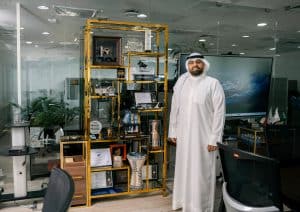
Long before joining Jazeera Airways, Alawwad was already working full time with only a high school diploma. From 2010 to 2014, he supervised one of the Touristic Enterprises Company’s facilities along Kuwait’s Arabian Gulf Street waterfront. When his supervisor resigned, however, the promotion went to someone with less experience. The explanation was simple. “We know you’re the most competent person,” his managers told him. “But this other guy has a bachelor’s degree.” Rather than argue, Alawwad resigned. He moved to the United Arab Emirates, enrolled at Ajman University, and earned a bachelor’s degree in Public Relations in December 2017. His university years also produced one story he still laughs about today. Most students try to graduate with the highest possible GPA. Alawwad had a different goal.
“I wanted a GPA of exactly 3.33 because I simply liked the number.” He even asked some professors to award him lower grades than he had earned so the mathematics would work out. “I was literally designing my grades to reach 3.33.” He missed. His final GPA was 3.32. “I was very disappointed because I missed it by just 0.01.”
After graduating, he returned to Kuwait and joined the Directorate General of Civil Aviation while also co-founding Bricks Design, an advertising and marketing company. For a period, he balanced both roles before eventually focusing full time on Civil Aviation. Although the business grew quickly, disagreements with his business partner eventually led him to step away. “I don’t regret the experience,” he says. “Running your own company teaches you things you simply cannot learn as an employee.”
The pandemic became another unexpected turning point. Working at Civil Aviation, Alawwad found himself coordinating digital systems, airport procedures, and public health requirements at a time when regulations were changing almost daily. The work brought him into regular contact with airlines and government agencies—and eventually caught Jazeera Airways’ attention. Today, he serves as Senior Manager of Government Relations and Projects and Head of Revenue Management, overseeing responsibilities that extend far beyond the Public Relations degree he once earned.
Two programs supported by the Kuwait Foundation for the Advancement of Sciences (KFAS) also shaped his development as a leader. The first was the High Potential Leader program, a three-month course that combined sessions in Kuwait with a final week in North Carolina. The second, a Harvard negotiation program, would have an even deeper impact.
“When I came back, something had changed,” he says. The change was not reflected in a new title or qualification. It showed in the way he approached people. He struggles to identify one lecture or one exercise that made the difference. Instead, the change happened gradually. Before Harvard, he says, he tended to make decisions quickly. Afterwards, he became more patient. “Now, before making a decision, I listen,” he says. “I ask more questions. I try to understand the other person’s perspective before reaching a conclusion.”
Harvard also changed the way he negotiates. Previously, he believed negotiation was mainly about convincing the other side. The program taught him something different. “First, understand what the other person actually wants. Sometimes people ask for one thing, but what they really need is something completely different. If you don’t understand that, you’ll never reach a good agreement.” The program also changed the way he leads his team. Today, Alawwad leads professionals from different countries, including India, Ethiopia, and Nepal. Instead of interrupting, he lets people finish speaking. Instead of assuming he already has the answer, he listens. “Sometimes they surprise me,” he says. “Sometimes they see something I completely missed.”
He also believes leaders have a responsibility to protect their teams. “If senior management has an issue,” he says, “I tell them, ‘Come to me. Speak to me. Don’t speak to my team.’” That same willingness to challenge authority extends to his own managers. “I always do what I genuinely believe is right,” he says. “When someone tells me to do something and I believe it’s wrong, I challenge it.”
For young Kuwaitis considering a KFAS program, however, his advice has little to do with titles or certificates. The certificate is probably the least important part, he believes. What matters is the experience. The people you meet. The discussions you have. The different ways of thinking you’re exposed to. The single lesson that has stayed with him throughout his career is neither strategy nor negotiation. It is “patience.”
“The Harvard program taught me that. Today, before making decisions, I listen. I ask questions. I try to understand. It has made me a better leader. It has made me better at negotiations. And, honestly, it has made me a better person.”