Last year, the world released roughly 40 billion tons of carbon dioxide — the heat-trapping gas produced by burning coal, oil, or natural gas, and widely recognized as the leading driver of climate change. Since the start of the industrial age, humanity has emitted over 1.5 trillion tons of CO2 into Earth’s atmosphere.
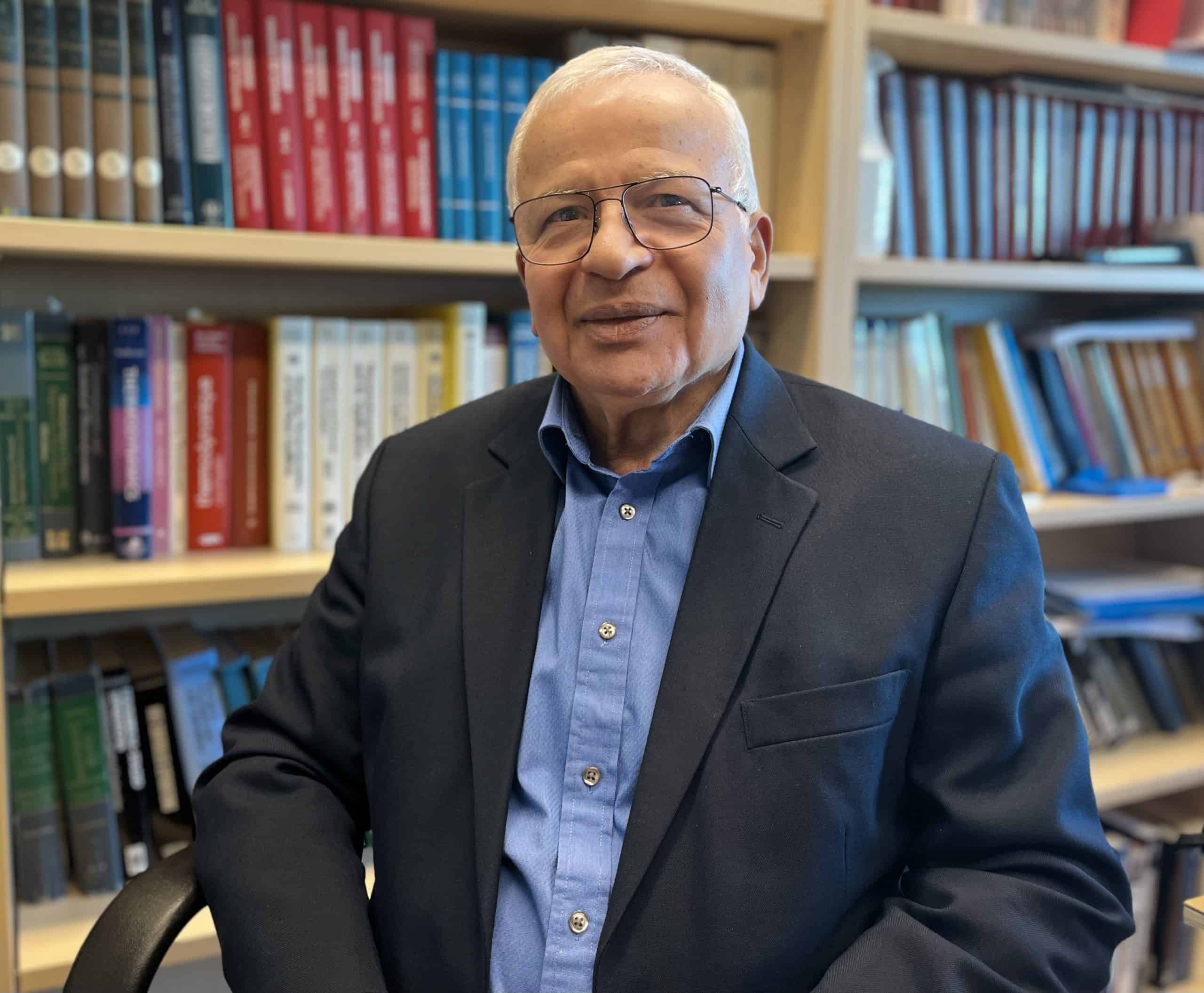
In Ottawa, Canada, Professor Abdelhamid Sayari is working to recapture as much of that CO2 as possible. At his laboratory at the University of Ottawa's Department of Chemistry and Biomolecular Sciences, the Tunisian-born chemist has pioneered carbon capture methods for more than two decades. "This is now a completely new industry," said Professor Sayari. "There are dozens and dozens of companies working on CO2 capture."
For his work, the Kuwait Foundation for the Advancement of Sciences has awarded him a 2025 Prize in Environmental Sciences.
In a way, Professor Sayari started at the opposite end of this issue. As a young man, he recalled, he had “100% decided” to study physics. But in his first two years at university — where physics and chemistry students took classes together — he found the chemistry professors far more compelling and switched fields. He turned to porous materials: honeycomb-like solids full of microscopic holes, giving them an enormous internal surface area that made them ideal for accelerating chemical reactions, a process called catalysis. During a postdoctoral fellowship at the University of Pittsburgh in the early 1980s, Professor Sayari used those materials to coax gas mixtures to form liquid hydrocarbons — “making artificial oil,” he said.
hen, in 1992, a research group at ExxonMobil published a paper describing a new family of porous materials — more ordered and uniform than any before. Professor Sayari jumped in immediately, spending the next several years learning to synthesize and manipulate these new substances. Before long, he and others in the field began asking what these materials could be used for. For Professor Sayari, the answer was CO2 capture.
At the time, some techniques for capturing CO2 already existed, but solely to purify valuable gases such as natural gas that commonly comes out of the ground mixed with carbon dioxide. The standard approach involved passing the gas mix through a liquid solution laced with chemicals called amines — compounds whose natural affinity for CO2 makes them act almost like molecular flypaper. The CO2 would stick to the amines and get pulled from the gas stream. To release it and reuse the solution, though, engineers had to heat the entire liquid volume — an undertaking that consumed vast amounts of energy. For companies purifying natural gas or hydrogen, the expense was worth it, Professor Sayari explained: those gases were valuable enough to justify the cost. But if the goal was simply to remove CO2 for the climate’s sake, the energy costs made the technology unworkable. Liquid amines also tended to break down over time, releasing noxious gases of their own.
Professor Sayari realized he could achieve the same result using porous solid materials. Instead of dissolving amines in water, he found ways to anchor them chemically to the surface of his “Honeycombs.” The result was a far less energy-intensive method, said Professor Sayari, whose papers have been cited more than 30,000 times.
The process works in three stages. First, the solid material captures CO2 from whatever gas flows through it, whether industrial exhaust or open air. Second, a burst of steam at about 100 degrees Celsius heats the material just enough to release the CO2 as a pure gas. The steam and CO2 can then be separated simply by cooling: the steam condenses into water, leaving behind pure carbon dioxide ready for storage underground or conversion into other products. Third, cooling the material to start the cycle again.
The key, Professor Sayari said, is choosing the right base material. "It has to immediately react, adsorb very quickly, release very quickly, and last very long." His carbon-capturing “Honeycombs” are made from substances like silica that form the basis of sand and glass.
إن المفتاح يكمن في اختيار المادة الأساسية المناسبة: «يجب أن تتفاعل فورًا، وتُمتَص بسرعةٍ كبيرة، وتُطلَق بسرعةٍ كبيرة، وتدوم فترةً طويلةً جدًًا». وتُصنَع «خلايا النحل» التي ابتكرها لالتقاط الكربون من مواد مثل السيليكا التي تُشكل أساس الرمل والزجاج
The approach works so well that companies including Svante in Canada, Climeworks in Switzerland, Carbyon in the Netherlands, and several American firms have built carbon capture technologies around amine-containing solid adsorbents like those Professor Sayari pioneered. The materials can be deployed at the exhaust stacks of power plants and cement factories, among the largest point sources of carbon dioxide. They can also be used for direct air capture: pulling CO2 from the open atmosphere, where it exists at far lower concentrations.
Whether carbon capture can make a meaningful dent in the climate problem, however, will come down to a factor beyond the science: scale. The amount of CO2 humanity releases into the atmosphere every year — those 40 billion tons — dwarfs anything else the world produces. To put it in perspective: The most widely intentionally manufactured chemical on Earth is sulfuric acid, a compound used in everything from making fertilizers to processing metals, refining fuels, and producing batteries — which is why factories worldwide churn out hundreds of millions of tons every year. Yet that entire global output pales against the carbon dioxide humanity pumps into the atmosphere, said Professor Sayari: "Every year we release an amount of CO2 equivalent to 150 years of production of sulfuric acid."

Recapturing a meaningful fraction of that would likely require thousands of installations worldwide. “To make a real impact, it has to be developed on a very, very large scale,” said Professor Sayari.
For now, he focuses on making his CO2 -capturing materials as durable as possible. The goal is to keep every unit operating for two years, running through 1 million capture-and-release cycles without significant loss of performance. He is also applying similar materials to remove heavy metals from wastewater and pollutants from air — work that accounts for roughly 20% of his research.
For now, he focuses on making his CO2 -capturing materials as durable as possible. The goal is to keep every unit operating for two years, running through 1 million capture-and-release cycles without significant loss of performance. He is also applying similar materials to remove heavy metals from wastewater and pollutants from air — work that accounts for roughly 20% of his research. Professor Sayari is hopeful that carbon capture will make a difference, particularly if paired with deeper cuts in coal and oil burning. He sees momentum building in Europe, Asia, and Canada, even as policy uncertainty has slowed progress elsewhere. "I think we are moving there," he said.
يركز حاليًا على جعل مواد التقاط CO2 التي يستخدمها أكثر متانة قدر الإمكان. الهدف هو ضمان استمرار تشغيل كل وحدةٍ لمدة عامين، مع إمكان إجراء مليون دورة التقاط، وإطلاق من دون أي تراجعٍ ملحوظٍ في الأداء. كما يستخدم مواد مماثلةً لإزالة المعادن الثقيلة من مياه الصرف الصحي والملوثات من الهواء