
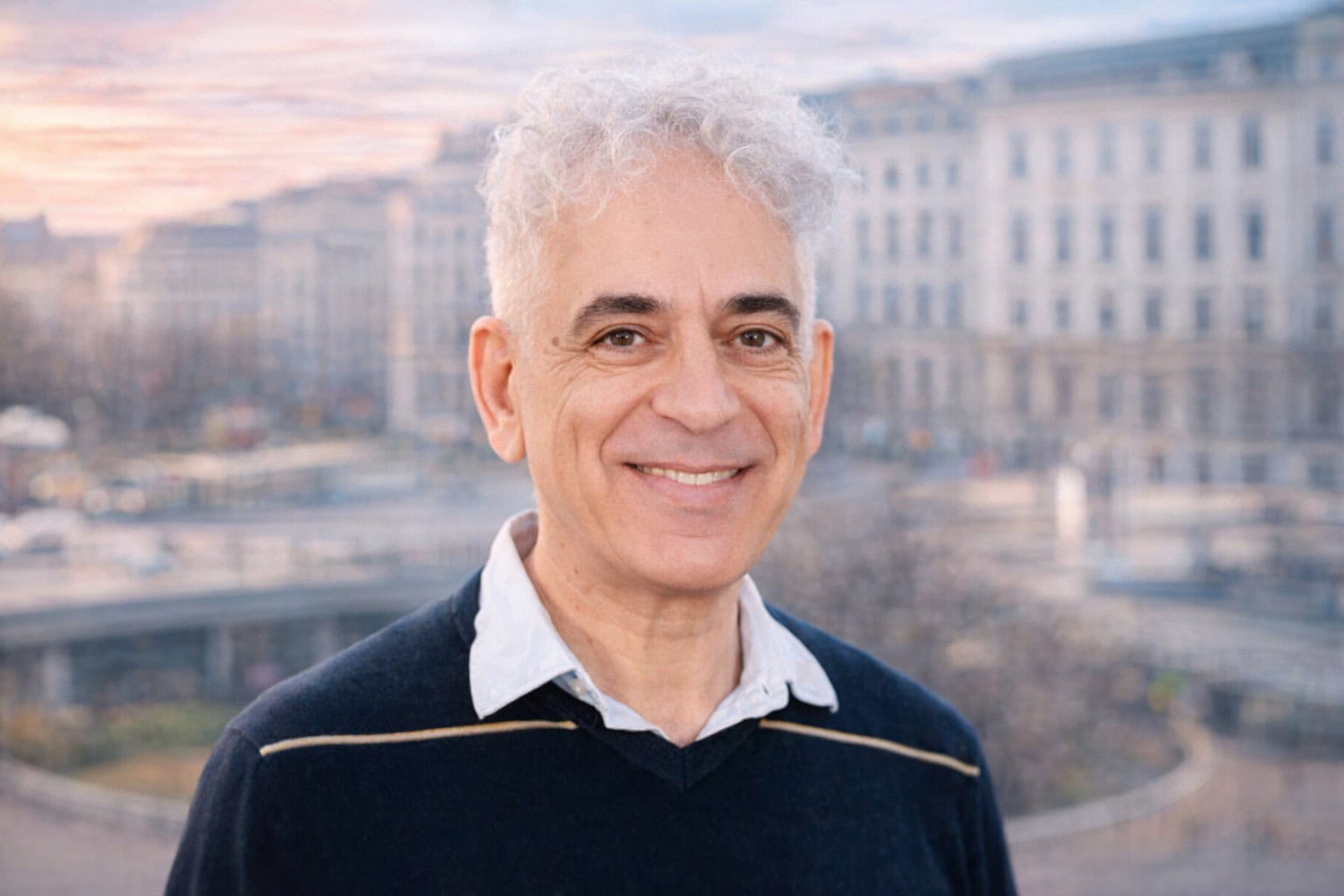
Since growing up Palestinian in Lebanon, Professor Mohammed Bamyeh has lived in 18 cities across four continents, including in two civil wars and two revolutions. Early on, he realized that the standard explanations for social turmoil didn’t satisfy him — they were often too pat, too simple. So Professor Bamyeh became a sociologist. He considered sociology to be “the one science” for analyzing the complexities of reality. “For me, it was the broadest social science," said Professor Bamyeh, now one of the leading scholars of the Arab world. "Within it, you can analyze political developments, economic developments, cultural transformations."
By now, Professor Bamyeh has written major books on globalization, the origins of Islam, anarchism, and the Arab uprisings, drawing on anthropology, political science, history, literature, and even cinema. He has served as president of the Arab Council for the Social Sciences. And he remains convinced that sociology — done right — is an urgent practical necessity, especially in a region where the problems it could address are both entrenched and profound.
Sociology helps people understand their reality at a more informed level and make better decisions about how they live and how they want to live, Professor Bamyeh says.
Currently a professor at the University of Pittsburgh in the United States, Professor Bamyeh has watched societies fracture during the Arab uprisings of 2011, then struggle to rebuild. Revolutions, he has concluded, are fundamentally communicative events. They begin when people from different classes, age groups, and regions learn to talk to each other. The opening phase succeeds when this coalition manages to express a broad social consensus — something approaching 75% of the population, by Professor Bamyeh’s reckoning.
But problems usually follow. "It is easy to have consensus about what you are against," he said, "but not really about what you want to replace it with." Once the initial goal — removing a head of regime — is accomplished, the groups that made up the movement often turn on each other, and the revolt can collapse into civil war, as happened in several countries after the Arab spring.
Sociology, Professor Bamyeh believes, can help societies learn from such failures. “It is this distance between what we expect, what we hope to accomplish, and our incapacity to get there — this is where sociology comes in. Why it didn't work, and how you can do it better."
The uprisings during the Arab spring grew out of the region's underlying problems — unaccountable governance, extreme inequality, and an inability to achieve the integration its shared language and history would seem to allow — all of which remain unresolved today, Professor Bamyeh notes. Yet although social science is, by his estimation, among the tools best suited to address these issues, they remain largely underused. In much of the Arab world, social science is rarely consulted, he says — and sometimes not even funded or taught.
He has spent much of the last decade studying the state of the social sciences in the Arab world, first as lead author of a landmark 2015 report for the Arab Council for the Social Sciences, and now completing a fifth report. The picture that has emerged from these reports is one of uneven development and persistent blind spots. While North African countries like Morocco and Tunisia have relatively established social science traditions and more academic freedom, countries like Iraq and Egypt have seen strong traditions disrupted by wars, sanctions, or government repression. In parts of the Gulf, universities have long functioned as prestige objects rather than sources of knowledge.
The neglect extends beyond sociology. “For example, we are told that Arab societies are conservative and traditional — that is propaganda, but that is what we are told,” said Professor Bamyeh. “But the science that actually studies traditions, mainly anthropology, is the least represented social science in Arab universities.” History programs are also underrepresented — something he finds curious, given how often Arab societies hear that their history defines them.
Three things, Professor Bamyeh argues, are necessary for social science to take root: a regionally integrated scholarly community that allows researchers in one country to engage with peers across the region; institutional continuity, so that scholars stay long enough in one place to build traditions and train students; and a strong civil society that uses and produces social science outside university walls. "If it is social," he said, "it has to live in society as well."
Rating systems, which many countries have adopted with the stated goal of improving institutions of higher learning, he finds counterproductive at best. Comparing a university in Benghazi to Harvard is meaningless, Professor Bamyeh argues — the only useful measure is the role a university plays in its own environment. Instead, rankings teach administrators the wrong habits, pulling their attention away from what works toward a number that may have little to do with their institution's real value. "I really wish that we just get rid of this ranking obsession," he said, arguing that it only serves to reestablish global hierarchies. "That is the colonial mentality that we have been living with all our life."
When social science is sidelined, it leaves a vacuum that other forces rush to fill, Professor Bamyeh warns. “The interpretation of our culture or history is left over to extremist groups or to serve narrow politicized interests, “So the marginalization of social sciences exposes society to dangerous trends.”
But Professor Bamyeh also sees reasons for hope, mostly among the young. In recent years, he has received far more invitations to speak at youth forums, reading circles, and debate clubs — most of which did not exist before the 2011 uprisings. "There is a thirst for knowledge,” he said, and a dawning understanding that going into the street and protesting isn’t enough.
Whether more revolutions are coming, he isn't sure. But something, he believes, is shifting. "The last thing revolutions change is the political system," he said. "The first thing they change is the culture. People, especially the young, begin to ask new questions."