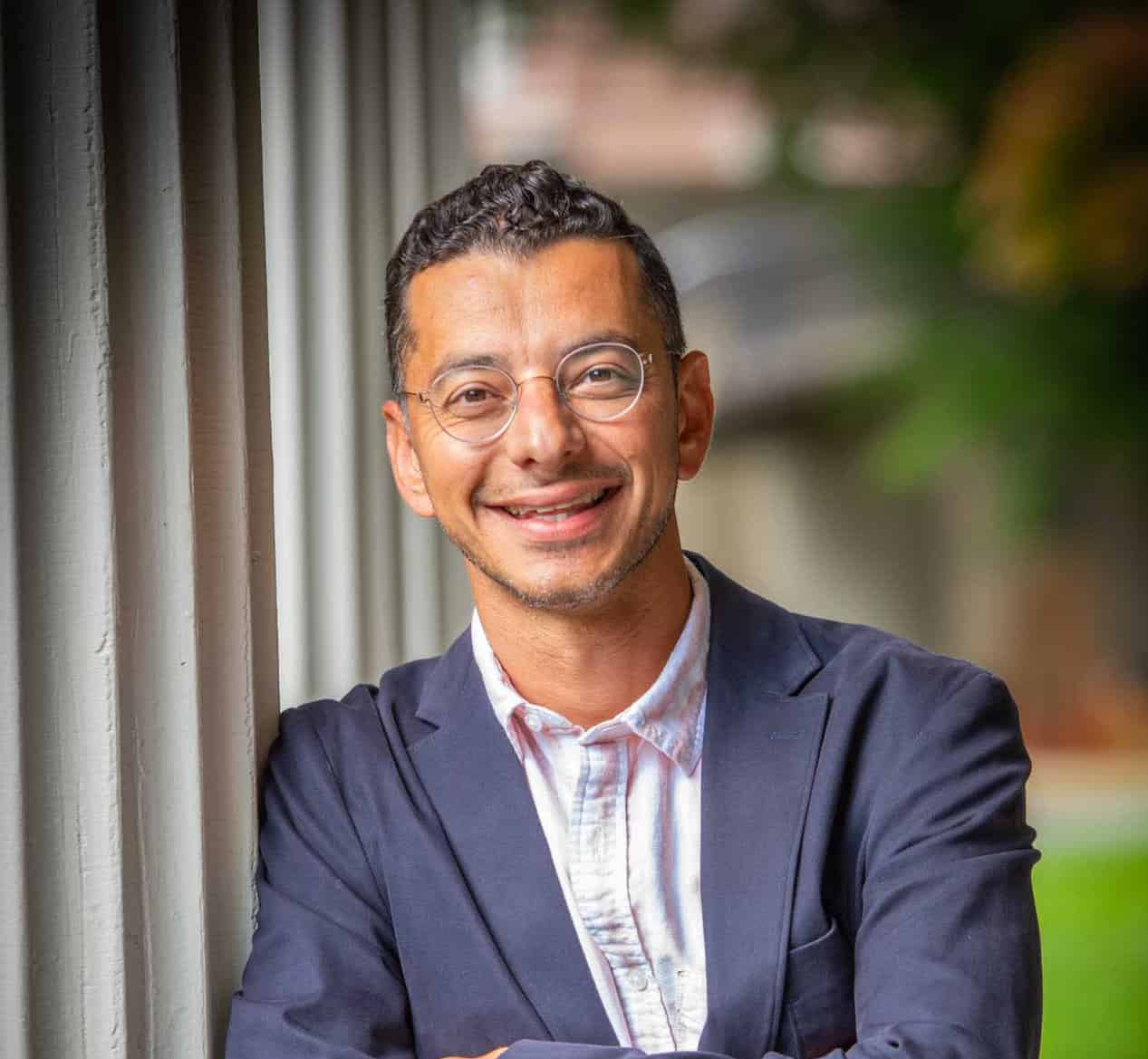
As a boy growing up in New Jersey, Professor Ahmad 'Mo' Khalil dreamed of rockets. He wanted to work in propulsion, in engineering for space. Accordingly, when it came to study, he picked mechanical engineering and chemistry as his subjects at Stanford University, then earned a PhD in mechanical engineering from MIT in Boston. But while he pursued that dream, his father fell ill with cardiovascular disease and underwent surgery. “This opened my eyes to problems in biomedicine and bioengineering,” said Professor Khalil, “and got me thinking about how, as an engineer, I might be able to create interesting new solutions.”
He pivoted to a new path that led him to one of science’s most extraordinary new disciplines. Today, Professor Khalil is the Hok Lam and Kathleen Kam Wong Professor of Bioengineering, and Professor of Molecular and Cellular Biology at Harvard University, where he runs a laboratory devoted to synthetic biology: the fundamental science and application of reprogramming living cells. His work earned him a 2025 Kuwait Prize.
Say researchers want to find a molecule that binds to a specific protein on the surface of a cell. They insert genetic instructions that prompt yeast cells to produce a variety of molecules
At the heart of synthetic biology is a bold idea: introduce new genetic instructions into a living cell and get it to perform useful tasks or ones that it would never do on its own. Make yeast produce a cancer-fighting antibody, for example. Or engineer a patient’s immune cells to hunt down tumours. It’s a challenging undertaking: a cell “is a constantly evolving and highly dynamic bag of chemical reactions,” Professor Khalil said. Billions of years of evolution have shaped it, and it does not always cooperate with new instructions.
The tools that allow scientists to try to program cells at all have been decades in the making. Starting in the 1970s, scientists learned to manipulate DNA; later, improved sequencing technologies enabled them to read the genetic code of virtually every living organism on Earth. “That gave us the catalogue,” said Professor Khalil. Now, his lab and others are using genes found across nature to design new combinations — what Professor Khalil calls genetic circuits — to make cells behave in new and useful ways.
Once the biology bug had bitten Professor Khalil, he did his doctoral work in a lab that engineered viruses to build physical materials such as electrodes. To do this, the researchers exploited the fact that a virus's outer protein coat can bind to specific metals and minerals, allowing vast numbers of them to self-assemble in solution into living scaffolds around which useful materials grow. Professor Khalil then did his postdoctoral work with Jim Collins at Boston University, one of the founders of the synthetic biology field, before joining BU's faculty for 12 years. He moved to Harvard in 2025.
Today, his lab has three main research areas. The first involves yeast — the same organism responsible for beer, bread, and wine. Professor Khalil's team inserts genetic circuits into yeast, turning it into a discovery machine. Say researchers want to find a molecule that binds to a specific protein on the surface of a cell. They insert genetic instructions that prompt yeast cells to produce a variety of molecules. If any of them bind to the target protein, the genetic instructions can trigger the yeast cell to produce a fluorescent substance, making it glow. Because yeast reproduces quickly and can be grown by the billions, researchers can simultaneously screen an enormous number of candidate molecules, then simply collect the glowing cells and study what they made. Professor Khalil and his team are using this approach to find antibodies for cancer treatments. He co-founded a company called Eira Bio, based in San Francisco, that aims to develop such antibody-based therapies.
Professor Khalil’s second area of research also targets cancer, but through cellular immunotherapy, specifically CAR-T cell therapy. The concept works like this: doctors take immune cells from a cancer patient’s own blood, genetically modify them outside the body to carry a new receptor — a kind of microscopic antenna on the cell’s surface that recognizes and grabs onto cancer cells — and then return them to the patient’s bloodstream. Once inside the patient, the redesigned cells seek out and attack tumours. The approach “has shown some really remarkable results in certain types of cancers,” said Professor Khalil. But CAR-T therapy does not yet work for all cancers, and reintroducing the modified cells can provoke dangerous immune reactions. Professor Khalil’s lab is developing genetic circuits to make the engineered immune cells more effective and safer. He is also looking beyond T cells to other immune system components — including macrophages and NK cells — hoping to deploy a broader arsenal of cells against cancer.
The third and newest focus area is plants. By 2050, Earth’s population is projected to hit 10 billion, and farmers may need to at least double their output to keep everybody fed. Meanwhile, climate change is destabilizing agriculture systems worldwide. “I believe that bringing new ideas and new technologies to plants is going to be very important,” said Professor Khalil. His team is working to accelerate the development of plant varieties that are, for example, more tolerant of drought. "How do we take what took thousands or even millions or billions of years of evolution and shorten that to get to these interesting plant varietals?" he asked.
Professor Khalil expects artificial intelligence to play an ever-greater role in synthetic biology
Professor Khalil, who grew up Palestinian-Jordanian and whose family moved frequently in the Middle East before settling in the United States, feels proud to represent Arab researchers and to receive the Kuwait Prize. “It's a wonderful thing to recognize Kuwaiti and Arab scientists around the world,” he said of the award. He is quick to credit his team. "This is the result of many years of amazing work of lab members past and present," he said. "I am lucky to be able to work with them."
In the future, Professor Khalil expects artificial intelligence to play an ever-greater role in synthetic biology. High-throughput automated experiments are generating richer biological datasets than ever before — and modern AI models are finding patterns in that complexity that can be used to engineer cells in smarter ways. "That's only really happened in the last three, four years," said Professor Khalil. "It's opening up an interesting direction for how you might begin to engineer that complexity.”